Evaluating Watercolor Rounded Stars for Digital Design Projects
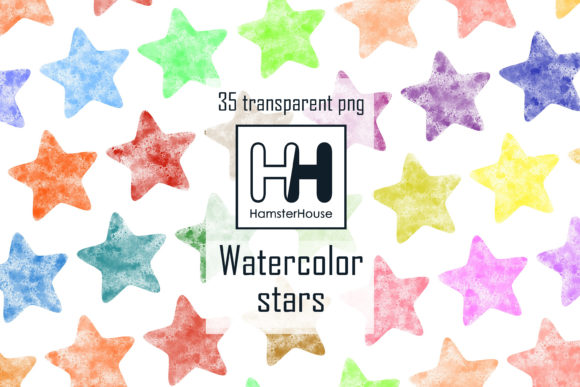
In the realm of digital design, particularly within sectors like wedding invitations, baby announcements, and children’s book illustrations, the demand for authentic, hand-crafted aesthetics remains consistently high. Among the various assets available to designers, Watercolor Rounded Stars have emerged as a versatile and popular choice. This specific clipart set offers 35 transparent PNG files, each featuring soft, organic star shapes rendered in a watercolor style. With resolutions exceeding 3100 pixels on the longest side, these elements provide the clarity and flexibility required for both web-based graphics and high-quality print materials.
When selecting digital assets, it is crucial to look beyond surface-level appeal. Designers must consider technical specifications, artistic consistency, and practical application scenarios. This evaluation explores the distinct characteristics of this watercolor star collection, comparing its utility against standard vector graphics, other clipart styles, and custom illustration workflows. By understanding the strengths and limitations of Watercolor Rounded Stars, creative professionals can make more informed decisions about when to incorporate them into their projects.
The Aesthetic Appeal of Soft Geometry
The primary distinction of this asset lies in its fusion of two contrasting visual concepts: the geometric precision of stars and the fluid unpredictability of watercolor paint. Traditional star icons are often sharp, angular, and rigid, conveyed through clean vector lines. In contrast, Watercolor Rounded Stars feature irregular edges, subtle color bleeding, and varying opacity levels that mimic the behavior of pigment on paper.
This aesthetic is particularly effective for brands and projects seeking to evoke feelings of warmth, nostalgia, or whimsy. The "rounded" aspect of the stars further softens the visual impact, making them less aggressive than traditional five-pointed stars. For audiences aged 20–50, who often appreciate minimalist yet emotive design, these elements strike a balance between modern simplicity and artisanal charm. The transparency of the PNG format ensures that these soft-edged shapes can be layered over backgrounds without harsh rectangular borders, allowing for seamless integration into complex compositions.
Technical Specifications and Workflow Integration
One of the most significant advantages of this clipart set is its technical resolution. Receiving files with more than 3100 pixels on the longest side addresses a common pain point in digital design: scalability. Many free or low-cost clipart images suffer from pixelation when enlarged for print purposes. With dimensions exceeding 3100px, these watercolor stars can be scaled up for large-format prints, such as banners, wall art, or high-resolution packaging, without losing integrity.
The use of PNG (Portable Network Graphics) with alpha channels is critical for this type of artwork. Unlike JPEGs, which force a solid background color, PNGs preserve the transparency of the watercolor washes. This allows designers to:
- Layer Effectively: Place stars over textured backgrounds, photographs, or gradient fills without creating awkward white boxes around the shapes.
- Adjust Opacity: Reduce the opacity of individual stars to create depth, shadows, or a sense of distance within a composition.
- Composite Easily: Combine multiple stars from the set to create clusters or constellations, adjusting size and rotation freely.
However, the reliance on raster images (pixels) rather than vectors (mathematical paths) does introduce a limitation. While scaling down is generally safe, extreme enlargement beyond the original pixel count will result in blurriness. Therefore, while 3100px is ample for most uses, it is not infinite. Designers working on massive outdoor billboards may need to seek custom vector illustrations instead.
Comparison with Alternative Asset Types
To understand where Watercolor Rounded Stars fit in the broader landscape of design resources, it is helpful to compare them with other common options available to creators.
Vector Icons vs. Watercolor Raster Art
Vector star icons are infinitely scalable and easy to recolor using software tools like Adobe Illustrator. They are ideal for user interface (UI) design, app development, and data visualization where clarity and precision are paramount. However, vectors often lack the emotional texture and organic feel that watercolor provides. If a project requires a clean, corporate, or tech-forward look, vectors are superior. But for editorial design, lifestyle branding, or artistic layouts, the Watercolor Rounded Stars offer a tactile quality that vectors struggle to replicate without extensive manual texturing.
Stock Photography vs. Clipart Elements
Some designers might choose to photograph physical watercolor paintings to achieve authenticity. While this yields unique results, it is time-consuming and requires access to physical materials and scanning equipment. Stock photography of painted textures can also be expensive and difficult to isolate cleanly. Pre-made clipart sets like this one offer a cost-effective middle ground, providing ready-to-use, isolated elements that save hours of editing time while maintaining a consistent artistic style across a project.
Generic Clipart vs. Curated Sets
The market is saturated with generic clipart, often characterized by inconsistent line weights, mismatched color palettes, and low resolution. A curated set of 35 transparent PNGs ensures stylistic cohesion. When all elements share the same brush strokes, color saturation levels, and edge treatments, the final design appears more professional and intentional. This consistency is particularly valuable for brand identity packages where every graphic element must align with a specific mood board.
Best-Fit Use Cases and Applications
Given the specific attributes of Watercolor Rounded Stars, certain applications yield better results than others. Identifying these use cases helps determine if this asset is the right tool for a specific job.
- Wedding and Event Stationery: The soft, romantic nature of watercolor pairs well with script fonts and floral elements. These stars can serve as delicate accents on save-the-dates, menus, or place cards, adding a touch of elegance without overwhelming the text.
- Baby and Child Products: The rounded, non-sharp geometry of these stars makes them safe and appealing for designs targeting young children. They work effectively on nursery decor, birthday party invitations, and children’s book covers, where a playful yet gentle aesthetic is desired.
- Social Media Content: For Instagram or Pinterest posts, the high resolution ensures crisp display on retina screens. Designers can overlay these transparent stars on photos to create engaging quotes or promotional graphics quickly.
- Scrapbooking and Digital Journaling: Hobbyists and digital scrapbookers benefit from the variety of 35 different variations. The ability to layer semi-transparent stars creates depth and visual interest in personal memory-keeping projects.
Limitations and Considerations
While versatile, Watercolor Rounded Stars are not a universal solution. Designers should be aware of several constraints before purchasing or integrating these assets.
Color Customization Challenges: Because these are raster images with baked-in colors, changing the hue of a star is more complex than with vectors. Using adjustment layers in Photoshop can alter colors, but it may affect the natural gradients and shading of the watercolor effect, potentially making the image look artificial. If a strict brand color palette is required, this may require additional editing effort.
Repetition and Uniqueness: With only 35 variations, designers working on large-scale projects (such as a 100-page book or a multi-year calendar) may find themselves repeating the same star images. To mitigate this, designers can rotate, flip, resize, and combine stars to create new compositions, but true uniqueness may require supplementing this set with other elements or custom illustrations.
Style Consistency Across Assets: If a designer’s project already includes heavy ink drawings, photorealistic elements, or flat geometric shapes, introducing watercolor stars might create a disjointed visual language. It is essential to ensure that the overall design theme supports the organic, painterly style of these stars.
Decision Factors for Buyers
When evaluating whether to acquire this specific clipart set, consider the following decision factors:
- Resolution Needs: Do you need high-resolution assets for print? If yes, the >3100px specification is a strong advantage.
- Time Efficiency: Are you looking to speed up your workflow by avoiding manual painting or complex masking? Transparent PNGs offer immediate usability.
- Aesthetic Goals: Does your project require a soft, handcrafted, or whimsical feel? If so, this style aligns well with those objectives.
- Budget Constraints: Compared to hiring an illustrator for custom watercolor art, a pre-made clipart set offers a significant cost saving for small to medium-sized projects.
Ultimately, Watercolor Rounded Stars represent a thoughtful intersection of artistic beauty and technical utility. They are not merely decorative dots but carefully crafted elements designed to enhance the emotional resonance of digital and print designs. By understanding their capabilities and limitations, designers can leverage this asset to create compelling, cohesive, and visually appealing work that resonates with their target audience.