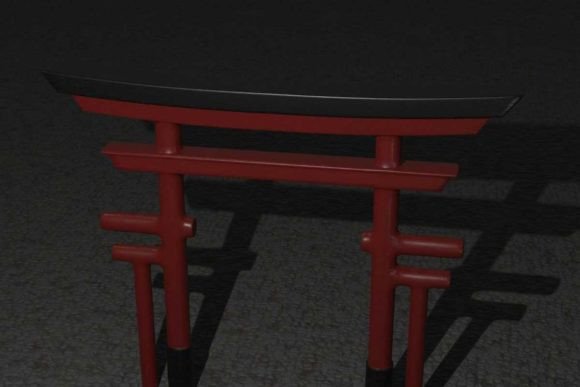
Integrating a Low Poly Torii Gate into 3D Scenes
A Torii Gate is far more than a simple architectural element; it serves as a profound cultural symbol, marking the transition from the mundane to the sacred in Shinto tradition. For 3D artists, game developers, and digital creators, incorporating this iconic structure adds immediate atmospheric depth and narrative weight to any scene. Whether you are designing a serene meditation app, a historical simulation, or a fantasy landscape, the right asset can elevate the visual storytelling significantly.
The specific low poly model discussed here offers a streamlined approach to achieving realism without the computational overhead of high-fidelity meshes. Created using Blender, this asset bridges the gap between artistic integrity and technical efficiency. It is designed to look authentic while maintaining a manageable polygon count, making it suitable for real-time rendering engines like Unity and Unreal Engine, as well as offline renderers such as Cycles and Eevee.
Understanding the Asset: Design and Technical Specifications
At its core, this Torii Gate project is built on the principles of low-poly aesthetics. The geometry consists of exactly 6,664 faces and 6,664 vertices. This precise symmetry is not just a coincidence but a testament to the careful topology planning involved. By keeping the vertex count low, the model ensures that it remains lightweight, which is crucial for mobile applications, VR experiences, or large-scale environments where draw calls matter.
Despite its simplicity, the model avoids looking flat or generic. The creator has focused on proportion and structural accuracy to mimic the appearance of a real-world Torii Gate. This attention to detail means that even at a distance, the silhouette reads correctly as a traditional Japanese gate. The lack of textures is a deliberate choice that enhances versatility. Instead of relying on baked texture maps, the model utilizes two distinct materials. This allows users to easily recolor the gate to match different lighting conditions, time-of-day settings, or stylistic choices without needing to unwrap UVs or manage complex texture atlases.
Rendering Capabilities with Blender
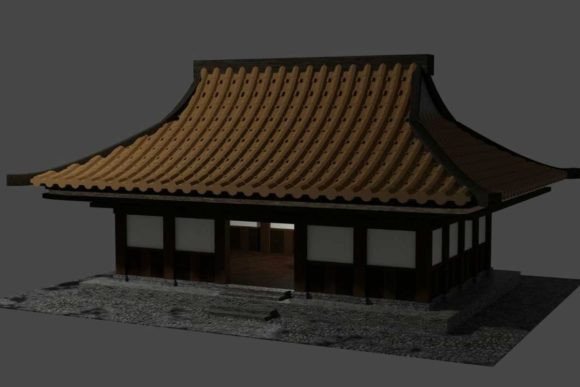
The preview images associated with this asset demonstrate its flexibility across Blender’s two primary rendering engines. When rendered with Eevee, the gate benefits from fast, real-time feedback, allowing artists to tweak lighting and material properties instantly. This is ideal for iterative design processes where speed is of the essence.
Conversely, when processed through Cycles, the ray-traced capabilities highlight the subtle interactions of light with the gate’s surfaces. Even without textures, the interplay of shadows and ambient occlusion gives the low-poly mesh a sense of volume and presence. This dual-rendering capability proves that the asset is robust enough for both stylized, cartoon-like projects and those aiming for a more grounded, realistic aesthetic.
Practical Applications Across Industries
The utility of a well-crafted Torii Gate extends beyond mere decoration. Its application spans various professional and creative domains, offering tangible value to different types of users.
- Game Development: Indie developers and hobbyists often work within strict performance budgets. A low-poly Torii Gate provides an authentic cultural landmark without compromising frame rates. It can serve as a checkpoint, a shrine entrance, or a boundary marker in open-world games.
- Architectural Visualization: For architects specializing in Asian-inspired designs or resort planning, this asset offers a quick way to populate scenes with culturally accurate elements. It saves time compared to modeling the gate from scratch, allowing professionals to focus on the broader landscape integration.
- Education and Cultural Preservation: Educators creating virtual tours of Japan or digital museums can use this model to teach students about Shinto architecture. The clean geometry makes it easy to dissect and explain the structural components of the gate, such as the kasagi (top beam) and shimaki (second beam).
- Marketing and Branding: Businesses looking to evoke themes of peace, tradition, or journey can incorporate this imagery into their digital marketing materials. A high-quality 3D render of a Torii Gate can be used in banners, social media content, or promotional videos to create a memorable visual hook.
Benefits of Using a Pre-Made, Multi-Format Asset
One of the most significant advantages of this project is its file format compatibility. The pack includes the original Blender file (.blend v3.0.0), ensuring that users have full access to the editable source. However, it also exports to industry-standard formats including FBX, OBJ, STL, ABC, DAE, and glTF. This breadth of support means the asset can be dropped into almost any 3D pipeline seamlessly.
Efficiency and Workflow Integration
For freelancers and agencies, time is money. Downloading a ready-to-use asset eliminates the hours required to model, rig, and UV map a similar object. The fact that it comes with no textures simplifies the workflow further. Artists do not need to hunt for wood grain maps or paint weathering effects if they prefer a clean, minimalist look. They can apply their own shaders or leave it as is, depending on the project’s needs.
Scalability and Reusability
Because the model is low poly, it scales well. You can place one gate in a close-up shot or replicate it dozens of times along a path in a wide-angle scene without worrying about overwhelming the GPU. This scalability is particularly beneficial for environment artists working on large-scale productions where optimization is key.
Considerations for Implementation
While the asset is highly versatile, there are practical considerations to keep in mind when integrating a Torii Gate into your projects.
- Contextual Placement: A Torii Gate carries specific cultural connotations. Ensure that its placement in your scene respects these associations. It typically marks the entrance to a sacred space, so positioning it incorrectly might confuse viewers familiar with the symbolism.
- Material Customization: Since the model relies on two materials, you will need to adjust these to fit your scene’s lighting. A bright white gate might look washed out in a sunny scene, while a dark red might absorb too much light in a dimly lit area. Experiment with emission values and roughness to get the desired effect.
- Scale Accuracy: Verify the scale of the gate relative to other objects in your scene. Torii Gates vary in size depending on their location and purpose. Using a standard human figure as a reference can help ensure the proportions feel natural to the viewer.
Why This Model Stands Out
In a market saturated with high-poly, texture-heavy assets, this low-poly Torii Gate offers a refreshing alternative. It prioritizes form and function over excessive detail. For creators who value clean code, efficient rendering, and modular design, this piece is an excellent addition to their library. It demonstrates that you do not always need millions of polygons to create something visually compelling and technically sound.
Whether you are building a tranquil garden simulator or a fast-paced action game set in feudal Japan, having a reliable, adaptable Torii Gate asset can streamline your production process. It allows you to focus on the bigger picture—crafting engaging narratives and immersive worlds—while trusting that the foundational elements are solid, optimized, and ready to use.